
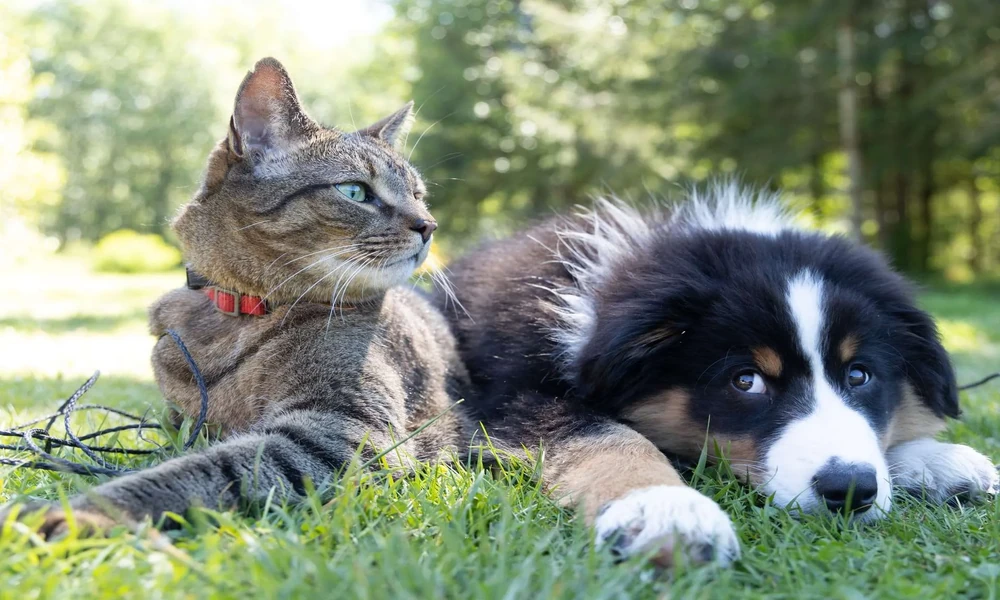
Dog training is teaching a dog to follow commands, behave safely around people and other animals, and respond reliably in different situations. Cat training is teaching a cat to use appropriate spaces, respond to cues, and reduce unwanted behaviors like scratching furniture or biting.
Both rely on the same core principle: animals repeat behaviors that get rewarded and stop behaviors that don’t. The difference is in motivation. Dogs are pack-oriented and often work for social approval as much as food. Cats are more independent and usually need a direct, tangible reward like a treat or a toy to stay engaged.
The American Veterinary Society of Animal Behavior (AVSAB) recommends reward-based methods for all dog training, including behavior problems, based on a review of current welfare research (AVSAB, 2021). The same logic applies to cats, according to feline behavior guidelines from the American Association of Feline Practitioners (AAFP, 2004).
How Dog Training Works: The Core Method
Dog training works by pairing a desired behavior with an immediate reward, then repeating that pairing until the dog performs the behavior on cue. This is called operant conditioning, and it’s the foundation of nearly every modern training program.
Here’s the basic cycle trainers use:
· Cue – You give a command, hand signal, or both.
· Behavior – The dog performs (or attempts) the action.
· Reward – You deliver a treat, praise, or play within 1-2 seconds.
· Repetition – You repeat the cycle until the dog responds without hesitation.
Timing matters more than most owners realize. A reward given three seconds late teaches the dog the wrong thing. AVSAB’s 2021 position statement notes that reward-based learning offers the most benefit and the least risk to the animal’s welfare, compared to methods that use corrections or discomfort.
Common early commands include sit, stay, come, and leash walking. Most dogs pick up a basic command within 15-20 short repetitions spread across a few days.
How Cat Training Works: The Core Method
Cat training uses the same reward-based cycle as dog training, but sessions need to be shorter and the rewards need to be more immediate. Cats have shorter attention spans for structured tasks and disengage quickly if the reward isn’t worth the effort.
A typical cat training session runs 3-5 minutes, once or twice a day. Cats respond well to:
· Clicker training – A distinct click sound marks the exact moment of correct behavior, followed by a treat.
· Target training – The cat touches a stick or your finger with its nose, which builds toward more complex behaviors.
· Litter box and scratching redirection – Rewarding use of the litter box or scratching post instead of punishing mistakes.
Unlike dogs, cats don’t respond to social praise the way dogs do. A treat, a favorite toy, or a few seconds of play work better than a verbal “good job.” The AAFP’s feline behavior guidelines emphasize that punishment increases fear and stress in cats without reliably stopping the unwanted behavior (AAFP, 2004).
Common Mistakes to Avoid in Dog and Cat Training
· Using punishment to stop bad behavior: This increases anxiety and can create new problems like aggression or hiding, in both dogs and cats (AVSAB, 2021).
· Training for too long: Dogs lose focus past 15 minutes; cats disengage after 5. Shorter, frequent sessions beat long ones.
· Inconsistent cues: If “down” sometimes means lie down and sometimes means get off the couch, the animal can’t learn a reliable response.
· Rewarding too late: A reward delivered more than 2-3 seconds after the behavior teaches the wrong association.
· Expecting cats to work like dogs: Cats aren’t less trainable, they just need higher-value rewards and shorter, more focused sessions.
Key Takeaways
· Dog training and cat training both rely on reward-based reinforcement, not punishment.
· Dogs handle longer sessions and respond to social praise; cats need shorter sessions and tangible rewards.
· Consistency in cues and reward timing determines how fast either animal learns.
· Punishment-based methods are linked to increased fear and behavior problems in both species, according to veterinary behavior organizations (AVSAB, 2021; AAFP, 2004).